
Season 1 · Episode 6 · 9 November 2026
Adriano: How the Emperor Disappeared
Lima, 25 July 2004. The final of the Copa América, third minute of added time, Argentina seconds from the cup. A 22-year-old in a yellow shirt turns and hits it with his left foot. Years later he would call it the happiest day of his life. Nine days later, his phone rang.
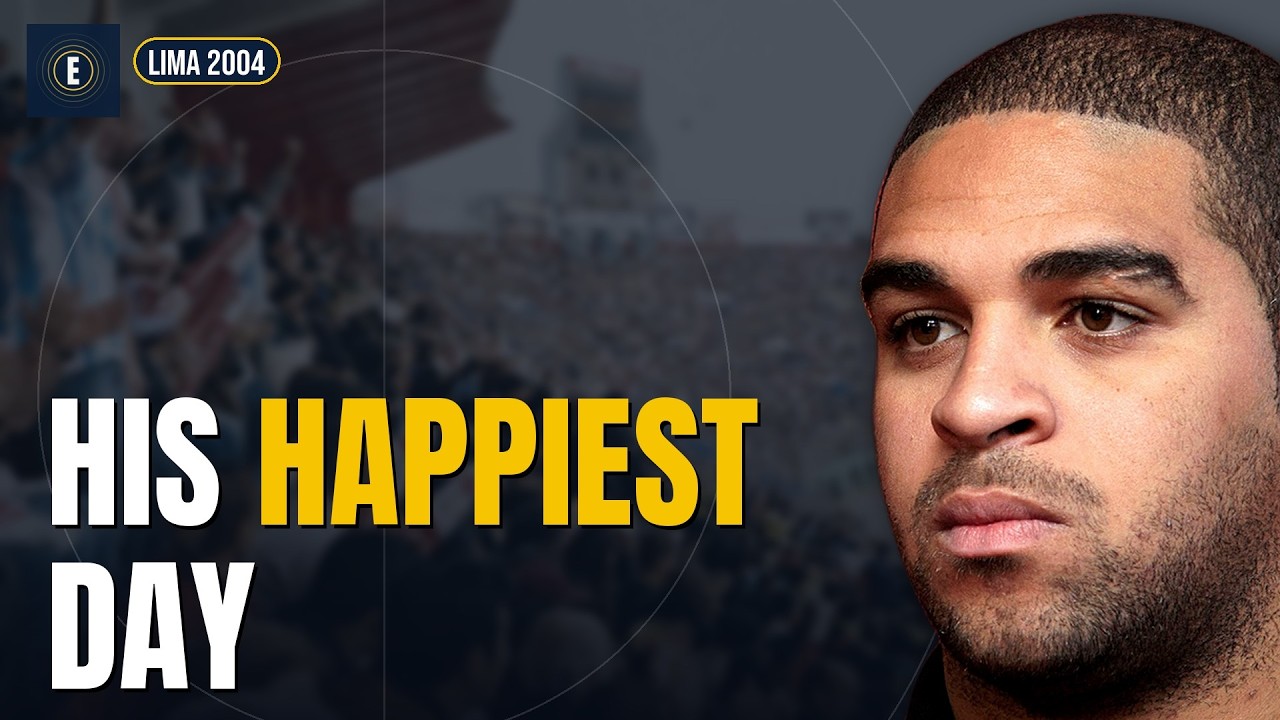
Within five years the same man was missing training, leaving Inter, and, by his own account, hiding on the hill in Rio where he grew up. So how does the man who scored that goal end up hiding from the world?
From Vila Cruzeiro and two buses a day to Flamengo, through the Bernabéu free kick at nineteen, Parma, Lima, King of Milan and the best year of his life, to the infirmary, Mourinho, three days on the hill, Flamengo's 2009 title and a night at the Maracanã in 2024. Where his own words are the only source, the text says so.
In this story: 20 chapters · about 35 minutes to read
- Added time in Lima
- The hill
- Two buses to the Gávea
- The bullet
- Cut day
- Flip-flops in Milan
- The free kick
- The dying club and the quiet town
- The road to Lima
- Nine days
- King of Milan
- The best year
- The title that was awarded
- The infirmary
- Bread, water and bed
- Three days on the hill
- The last great season
- The wrong turnings
- The last battle
- Back to Lima
1Added time in Lima
He would call it the happiest day of his life.
Nine days later, his phone rang.
Lima. 25 July 2004. The final of the Copa América. Third minute of added time. Argentina are seconds from the cup.
2-1 up. A substitute, Cesar Delgado, put them ahead with three minutes of normal time left. There is no extra time here. If the clock runs out, it is over.
A high, looping ball comes into the box from Brazil's right. Bodies jump. Nobody gets a clean head on it. It drops into a scramble. It falls to a big young striker in a yellow shirt. Adriano. He flicks it up with the toe of his boot. He turns. Before it can bounce, he hits it with his left foot, as hard as he can.
The ball flies past the defenders and into the corner. Roberto Abbondanzieri, in the Argentina goal, is beaten. 2-2.
43,000 people have changed their minds in one breath. He tears off his shirt. He is booked for it. The Brazilians celebrate in front of the Argentine bench. A brawl breaks out. The referee calls in the riot police.
Then the shoot-out. Julio Cesar saves one. An Argentine shot sails over the bar. Adriano takes Brazil's first penalty, and scores. Brazil win it, 4-2.
Seven goals. The top scorer of the tournament. He was 22, and one of the most feared strikers in the world.
Within five years, this same man would be skipping training. Drinking until he could not stand. Vanishing from his club for days. And finally, at 27, hiding in the neighbourhood he grew up in, while rumours spread across Rio that he had been kidnapped.
So how does the man who scored that goal end up hiding from the world?
This is the story of Adriano, the Emperor. The goals that made Inter's fans call him a king. The club that, by his own account, covered for him instead of stopping him. And a voice that came back to him at the Maracanã, 20 years later.
Nobody who knew him thinks there is one clean answer. But the story starts on a hill in Rio de Janeiro, with a ball, and a father. Remember him.
2The hill
Everybody knows the postcard of Rio. The beach, the Sugarloaf, the statue with open arms. Adriano Leite Ribeiro was born in Rio on 17 February 1982, and he never lived on the postcard.
He grew up on the other side of the city, in the north, in a favela called Vila Cruzeiro, in the district of Penha, in the shadow of a church built on a rock.
A favela is a hillside neighbourhood that grew up without permission and without much help. Houses built by their owners, brick by brick, as money came in. Electricity pulled from the street. Narrow stairs instead of roads. Armed gangs ran many of these hills. The police came in rarely, and when they did, it was with armoured vehicles.
But listen to how Adriano himself describes it. In the story he wrote for the Players' Tribune in 2021, he does not tell a tale of misery. He writes about fun. A place where everybody knew everybody. Kids with no shoes, kicking a ball on a dirt pitch from morning to night.
As he remembers it, home was two small rooms, always full of relatives. His grandmother Vanda had raised eight children by selling fruit and vegetables from a cart. His mother, Rosilda, worked in a clothes factory and held everything together.
And the dirt pitch had a boss. His father. Almir Leite Ribeiro, known to everyone as Mirinho.
In Adriano's memory, Mirinho organised the local football and picked the teams for the big matches. During the week he worked as a messenger in offices downtown. At weekends he belonged to that pitch. He was the man neighbours came to when they had a quarrel. A kind of unofficial mayor of one small hill. Adriano calls him his idol.
And the boy was already, at six or seven, enormous for his age. Big hands, big legs. He chased every ball in sight, played with grown men, and was not afraid of them.
His mother saw that nothing else interested him. And she knew where a boy like that could get a real chance. Her own father had followed one club on the radio every weekend of his life. Flamengo.
But Flamengo's training ground was on the other side of Rio. And nobody in the family had any money.
3Two buses to the Gávea
Flamengo is not just a football club in Rio. It is closer to a religion. Tens of millions of Brazilians call themselves part of the Nacao, the Flamengo nation. And the club's youth academy, in the leafy neighbourhood of Gávea, has a reputation for turning hopeful boys into professionals.
Getting in cost money. A membership, a training fee, a bus fare. So, Adriano writes, the family pooled what they had. Aunts, uncles, everybody threw something in. He was about seven.
And then, every day, his grandmother took him there. Two buses from the hill to the Gávea, and the same two buses back. He puts it at something like eight years of that routine. Every single day.
There was no money for proper lunches. His grandmother's idea of a training-day meal was a bag of popcorn, or bread with sugar. Adriano tells it with a smile. She did not just take him to training, either. She stood on the touchline and shouted his name, one syllable at a time. And on the bus home, she explained, at length, everything he had done wrong.
As he remembers his first trial, he had never played on grass. His first touch was a tackle. He won the ball, ran with it, and scored. The staff looked at this seven-year-old and did not believe his birth certificate. Too big. Too strong. They asked the family to bring a certified copy.
School and football did not mix well. He had to repeat more than one school year, he admits. But the football was working. A place in the futsal team at around nine, where the fees were dropped and small bonuses began to arrive. At 12, a place in the main youth side, and his first wage. About half a Brazilian minimum wage, by his own count. Money that went home.
And there was a small, sweet thing he never forgot. A team-mate from a richer part of the city, a boy called Wilson, more or less adopted him. Took him home. The first time he watched football on a big television. The first microwave he had ever seen. Cotton sheets. A fridge full of food, and a dinner table where he was afraid even to cough.
At about 13, he saw the sea for the first time. Rio is a city built around its beaches, and he was 13 before he got there. The same year, he says, he walked into the Maracanã for the first time, to watch his grandfather's club.
So far, this is a story about a family that gave everything to one boy. But the first thing that went wrong did not happen to the boy.
4The bullet
It happened to his father.
Adriano was about ten. There was a party in Vila Cruzeiro, the kind of evening that happens every weekend on a hill like that, with music and drinks and neighbours. And then shooting. In the letter he wrote in 2024, Adriano describes how a stray bullet hit his father in the head.
The bullet could not be taken out. Mirinho survived. But from then on he suffered seizures, over and over, and he never worked again. This is Adriano's own account, and it is the only account there is. But everything he later said about his father goes back to this one night.
The family got through it the way favela families do. With each other. Rosilda carried the weight. Neighbours turned up with food and with clothes. It was not the state that saved them, in his words, and not even football. It was the hill.
Sometimes the seizures came at night, and the family carried Mirinho down the hill to a hospital. Once, the doctors said he would not survive, and the whole family sat up all night praying. He did survive. They called it a miracle.
Adriano remembers his father's pain, and the hallucinations that came with it. And he remembers that Mirinho kept going. Kept organising the football. Kept settling quarrels, with a bullet still in his head. On the hill, he was still the king of Vila Cruzeiro.
Which makes the next story, a funnier one, a little bittersweet. When Adriano was 14, the local pitch got floodlights and a new name, Ordem e Progresso. Order and progress. There was a party to celebrate. And that night, Adriano drank his first beer.
His father saw it. He walked over, took the cup out of the boy's hand, and threw it away. In Adriano's telling, Mirinho never drank, because his own father had drunk himself to death while still young.
There is a funnier version of that evening that goes around the hill: that Mirinho took out his false teeth and dropped them in the boy's glass. Nobody has to choose between the two. The point is the same.
Keep that cup in mind. A father who knew exactly where it could lead, and who stood between his son and it. For eight more years, he would be there.
But first, the boy had to survive being cut.
5Cut day
There was a bad patch first. At 14 and 15, by his own count, he was tired and hungry, with a coach who did not believe in him. Once a bus broke down, he arrived 30 minutes late, and he was benched. In training, they made him play the part of a cone, a marker for the others to dribble around.
And at 15, he was nearly thrown out. He tells it in his Players' Tribune story. He had been moved to left back, he was ordinary there, and the club was ready to let him go.
The way he remembers the day itself, Flamengo held a yearly cull. The boys were sorted into two lines, in alphabetical order. A for Adriano. So he stood first in the line of boys who were going home.
Then the man in charge of the youth teams, Carlinhos, happened to walk past. He saw the line. He stopped it. He had been watching this boy since the very first day, he said, and this one was staying.
Adriano reckons that if Carlinhos had gone to the toilet three minutes earlier, his whole life would have turned out differently.
So they put him up front, where he belonged. He grew to about one metre 90. And early in 1999, at nearly 17, sitting in a class of 12-year-olds, he did something he later described like a scene from a film. In the middle of a lesson, he stood up, walked to the school gate, told the guard to open it, and never came back.
Then, early in 2000, came the story every Flamengo fan can recite. He is still a youth player, but he is allowed into the first team's pre-season. He lines up against two of the first team's big defenders, Juan and Ronaldao. He takes a shot. It hits the crossbar, and the rebound flies all the way out to the centre circle. And the coach walks over and offers him a professional contract.
Nobody has ever proved a word of that, and nobody in Rio wants to.
By Adriano's own account, the deal was about 15,000 reais a month. For a family from the hill, a fortune. The agent was Gilmar Rinaldi, a former Brazil goalkeeper. Nike came calling. And the Rio version of the next part is that Adriano asked Nike not to pay him in cash, but in a flat. A rented flat in Barra da Tijuca, in a nicer part of the city. The first proper home his family had ever had.
His first match was in February 2000, away in São Paulo. He came on in the second half, and within a minute he scored. Flamengo won 5-2. He was 17.
That November, at 18, he made his debut for Brazil, as a substitute against Colombia in a World Cup qualifier. He tells one more story from that time. Flamengo lost a home match to Sport Recife, and the Sport coach that day, Emerson Leao, soon became the coach of Brazil. Leao called him in and told him he had watched him fight on a night when the game was lost. That, in Adriano's version, was why he got the call.
So by the summer of 2001, at 19, one of the biggest clubs in Italy wanted him.
He was about to leave the hill for the first time in his life. And he would go dressed exactly as the hill had dressed him.
6Flip-flops in Milan
The club was Inter. In August 2001, Adriano moved from Flamengo to Milan, in a three-club deal tied to a Brazilian midfielder called Vampeta, who was co-owned by Inter and Paris Saint-Germain and went the other way, to Flamengo. In Inter's books, Adriano was valued at about 13 million euros in the swap. An accounting number, not a cash fee. But it tells you what Inter thought they were buying.
For the boy himself, by his own account, there was a signing-on bonus of 700,000 reais, paid at once. And the first thing the family got with it was a car.
As Adriano tells his arrival, he walked into Inter in shorts from the favela and flip-flops. Massimo Moratti, the owner, shook his hand and noticed how strong his hands were. The plan was to loan him out. And, he recalls, he told Moratti: if I travel to Madrid with the team, they will not want to send me away.
Moratti smiled and said, in bocca al lupo. Into the mouth of the wolf. It is the Italian way of saying good luck.
Remember that phrase. Moratti will say it to him one more time, eight years later, and it will mean something very different.
Inter's attack was already crowded. Vieri, Recoba, Kallon, Ventola. And, coming back from a long knee injury, Ronaldo. On paper there was no room for a teenager. But the first people to be kind to him were the stars. Ronaldo himself invited the 19-year-old home for dinner. Black beans, the taste of Brazil, and a new baby in the house.
At the training ground, Adriano stayed behind after sessions to take free kicks with Marco Materazzi and Clarence Seedorf, who had noticed how hard the kid struck the ball. Keep that detail. It is about to matter.
But the nights were another matter. Milan was cold. He had no Italian. He lived in a hotel, and for months, he recalls, he ordered the same thing from room service. Toast and Coca-Cola.
And then there was Christmas. In his 2024 letter, Adriano writes about his first Christmas in Milan. He is alone. He calls home, and hears the family together without him. He writes that he put the phone down, opened a bottle of vodka, and cried.
He was a lonely 19-year-old in a foreign country, and it was one night. But it is the first time a bottle turns up in this story. It will not be the last.
7The free kick
Back to that summer, and that promise to Moratti about Madrid. Real Madrid, in August 2001, were the most glamorous club in the world. They had just added Zidane to Figo and Raul. Every summer they hosted a friendly tournament in their own stadium, the Trofeo Santiago Bernabéu. On the 14th, Inter came to play.
Christian Vieri scored first for Inter, and the great Fernando Hierro pulled Madrid level. Adriano, 19, was on the bench. He came on in the second half, wearing number 14. And from the moment he touched the ball, he would not give it up.
He takes the ball and runs at the Madrid defenders. He dribbles past them, one after another, until somebody brings him down. Free kick to Inter.
Marco Materazzi, the big defender, walks over to the ball, because he wants it. But Clarence Seedorf steps in. He has seen this kid hit free kicks after training. He tells Materazzi to leave it to the boy.
Adriano puts the ball down. Iker Casillas, in the Madrid goal, waits. Adriano hits it with his left foot. The ball is gone. Casillas does not even get his hands to it. 2-1 to Inter.
That is the version Adriano and Seedorf tell. In another telling, he had nutmegged the Madrid defender Michel Salgado a few minutes earlier, and Hierro had hacked him down for the free kick. One account even has his coach, Hector Cuper, telling him to take it.
And how fast was the shot? Adriano himself, in a letter on Inter's website for the 20th anniversary, says 170 kilometres an hour. Other Inter articles give other numbers. The numbers move around, as they do. Nobody doubts it was ferocious.
He wrote that he had practised that left foot at home and in the street for years, and that it drove his mother crazy. The shot was his way of saying hello to the world.
And Inter's captain, Javier Zanetti, wrote in his autobiography what went through his head at that moment. This is the new Ronaldo.
He was 19. And still, Inter sent him away.
8The dying club and the quiet town
In January 2002, Inter loaned him to Fiorentina, a famous club coming apart at the seams. On his debut, away at Chievo, he scored an equaliser in the 89th minute. A week later, in his first home game, he scored again in the last minute, to hold Milan. Six goals in 15 league games, many of them in the last minutes, in a team that kept losing.
But it was not enough. Fiorentina went down, and that summer went bankrupt. That is a different story, and it gets an episode of its own, the next one in this series. What matters here is that a 19-year-old played well and watched the grown-ups around him fail.
So Inter tried again. That summer they agreed a co-ownership deal with Parma. Parma took half of him, and Inter got the defender Fabio Cannavaro in return. Parma was a smaller club, in a small city, with a coach who understood young strikers. Cesare Prandelli. Adriano says Prandelli taught him the craft of being a number nine. When to move. When to wait.
And there was a partner. A Romanian called Adrian Mutu, quick and clever. Between them, that season, they scored 33 league goals, and little Parma finished fifth. Mutu has said they got on at once, and became friends. The craft, the partner, the small quiet city. For one season, everything around the boy worked.
His family came to Italy, an uncle called Papao among them. In Adriano's telling, there was one night before a match against Juventus when his father had a seizure in the family's flat, after he had cut back his medication. A run to the hospital in the dark. Adriano played the next day, and scored.
Mutu left for Chelsea in the summer of 2003, and the partnership ended. Adriano stayed, made a fast start, and the big clubs noticed. In January 2004, Inter bought back Parma's half for more than 20 million euros. He had left Inter as a teenager on loan. He came back as the signing.
He moved into a house by Lake Como. On the first night, he says, there was no electricity and no heating, and he slept on two mattresses on the floor. In the second half of the season he kept scoring, and Italy found a name for him. L'Imperatore. The Emperor. The nickname is usually explained like this: in Italian, Adriano sounds like Hadrian, the Roman emperor.
So the question is not yet how he fell. At 22 he had not fallen at all. The question is what was waiting for him. And it was waiting that very summer.
9The road to Lima
In the summer of 2004, the Copa América was played in Peru. Brazil left most of their famous names at home and sent a young side, with Adriano as the centre-forward.
The first match, against Chile, was won with a goal in the very last minute. Then he scored a hat-trick against Costa Rica. Then came a defeat against Paraguay. Two more in the quarter-final against Mexico. Another in the semi-final against Uruguay, which Brazil won on penalties. Brazil had made a habit of surviving the last minute. And the seventh goal came in the final. You have seen it.
He flew back to Italy to join Inter for the pre-season. Everybody wanted to shake his hand.
Remember the word he used for that day. The happiest of his life. He said it years later. Because in Lima, with a medal round his neck, he could not have known what the next nine days were going to hold.
10Nine days
This part is hard to tell, so I will tell it plainly.
Early in August, nine days after the final in Lima, Inter were on their pre-season trip in the south of Italy. By Adriano's own account, he was on the team bus in Bari when his phone rang. Someone from home told him that his father, Almir, was dead. A heart attack. He was in his mid-forties. 44, by most accounts.
The captain, Javier Zanetti, was with him. Zanetti has told journalists what he saw. Adriano threw the phone down and started shouting that it could not be true. It was impossible.
Adriano has said that his father's death changed his life for ever, and that after that day his love for football was never the same. In the Players' Tribune he says, simply, that he could not cope with it.
Then there was the funeral. Adriano has said, on a Brazilian podcast in 2023, that he did not find the courage to go. He adds that he does not know if that was a mistake. His younger brother, then about five years old, told him, as Adriano remembers it, you are my dad now.
The man who had taken the cup out of his hand was gone. He was 22.
So he did what he knew how to do. He went back to work. Inter played Basel in a Champions League qualifier, and 19 minutes in, Adriano powered past two defenders and scored. UEFA's report noted that he had only just rejoined the squad after his father's death. Late in August he scored again, in the return leg at San Siro, and Inter went through.
Zanetti says that Adriano kept scoring, and kept dedicating the goals to his father. Adriano himself said, years later, that when he scored, he scored for his family.
The club did what a club could do. Zanetti says that he and Moratti agreed to look after Adriano like a younger brother. At a public training session in Milan, as Adriano tells it, the fans held up a banner. For better or for worse, Adriano is our emperor. He cried, and took it home.
Zanetti would say, many years later, that failing to lift him out of what came next was the biggest defeat of his career. Hold on to that. Because that autumn, nobody could see anything wrong at all.
11King of Milan
That autumn, the football got better. In October, Inter's fans gave him a title. King of Milan. A hat-trick against Messina. Goals that looked as if he had been born to score them. Inter had not won the league since 1989, and suddenly they had a striker that other clubs envied.
And one goal people still show young players. 28 November 2004, at San Siro. Inter against Juventus, the league leaders. Juventus are one up, and then they win a penalty. The man who takes it is Zlatan Ibrahimović. Yes, that Zlatan, two years before he joined Inter. He scores. 2-0.
About five minutes left. Inter's coach, Roberto Mancini, has thrown on two more strikers, and Vieri pulls one back. Then a cross comes in from Obafemi Martins. Adriano does not stop it. He does not control it. He volleys it, first time, left foot, into the net. 2-2. San Siro goes mad.
The money, the cars and the fame all arrived at once. But so did something else. He did not like being alone with the silence.
Photographers followed him around Milan's nightclubs. By some accounts, the answer was to bring the party to him: his house by Lake Como had a nightclub in the cellar, where he could drink and dance without being photographed. By one count, 60 photographers waited in the street outside.
And at Christmas, the first break he got, he flew straight to Rio. He went to Vila Cruzeiro, took off his shoes, put on shorts, and walked barefoot up the hill, knocking on the door of every old friend. No photographers. Nobody asking him for anything. In Rio, he has said, he felt free.
In January, the tale runs, the hill came to him. Some 50 relatives, friends and neighbours from the favela flew to Milan to visit. Moratti sent the team bus to collect them. It is said that on the pavement they gathered snow and ate it, because they had never seen any.
He was 22, and 50 people were suddenly looking to him. Remember the question. How does a man end up hiding from the world? Part of the answer may already be here. In Milan he could not stand the silence. On the hill, he felt free. But that spring, he had the best football of his life to play.
12The best year
15 March 2005. The Champions League, round of 16, second leg. Inter against Porto at San Siro. Porto were the holders. They had won the cup the previous May, under a young coach called José Mourinho. Remember that name. The first leg had ended 1-1.
Adriano scores in the sixth minute. He scores again in the second half. And again two minutes from time. A hat-trick against the champions of Europe. Inter win 3-1, and Porto become the first holders ever to go out before the quarter-finals.
In the quarter-final, Inter drew the other team from their own city. Milan won the first leg, 2-0. A week later at San Siro, with Milan leading and the tie almost gone, flares came down from the Inter end, and one hit the Milan goalkeeper, Dida. The match was abandoned. UEFA gave Milan a 3-0 win.
So Adriano took it out on Roma. In June, in Rome, the first leg of the Italian Cup final, both of Inter's goals were his. A hard strike from distance, then a header from a free kick. Inter won the second leg too, and lifted the cup for the first time in 23 years. Adriano missed that second leg. He was already away with Brazil.
Because the Confederations Cup was starting in Germany. In the semi-final, he scored twice against the hosts. And the final, in Frankfurt, was against Argentina. Again. The team he had broken in Lima.
11 minutes in, Adriano puts Brazil ahead. Kaka makes it two. Ronaldinho scores just after half-time. And in the 63rd minute, Adriano scores again. 4-1. He wins the Golden Ball for the best player and the Golden Shoe for the top scorer.
A Brazilian website called it the peak of his career. The numbers agree. He was 23.
That summer the numbers around him got bigger too. Reports spoke of a new contract and a release clause said to be 200 million euros. And he spent, on cars above all. A Ferrari, a Porsche, a Bentley, a Hummer. There was even talk of a yacht.
And there is the story of 2 April 2005, the day Pope John Paul the Second died. The story goes that Adriano wanted to go to Rome that evening to party, and when no seats were left on any plane, he chartered one.
There is a funnier one, about two friends from Vila Cruzeiro who flew to Milan through Lisbon. In Adriano's version, Portuguese border police took them for illegal immigrants and held them, until Adriano faxed a guarantee from Milan.
At 23 he could buy anything he wanted. A plane. A yacht. What he could not buy was his father back. And the next season, for the first time, the goals began to dry up.
13The title that was awarded
It did not look like it at first. In December, against the other side of the city, Milan, he scored twice, including the winner, in a 3-2 derby. Later came a hat-trick against Treviso.
But the goals dried up in the second half of the season. By his own account, there was friction with the coach, Roberto Mancini. And Inter finished third, a long way behind Juventus.
Then, in May 2006, a scandal broke in Italian football. It is called Calciopoli. It rested on wiretapped phone calls, in which Juventus's general manager, Luciano Moggi, was heard talking with the men who picked the referees. Over the summer, the sports courts handed down their verdicts. Juventus were relegated and lost two titles. Milan were docked points. And the title for 2006 was given to the club that had finished third. Inter.
So when you hear that Adriano won the league with Inter, remember the wording. That title, the scudetto, was awarded, by a committee, in a summer of courtrooms. Not won on the pitch in the spring. Inter count it. People have been arguing about it ever since.
That same summer Inter signed two new strikers, Hernan Crespo and Zlatan Ibrahimović. Adriano was no longer the only star.
At the World Cup in Germany, he scored twice, and Brazil went out to France in the quarter-final. In his book he writes that to win you must be perfect and lucky, and they were neither. He says he was three kilos overweight.
A baby also arrived that summer. His son was born during the tournament, and reports said that after his goal against Australia he and Ronaldo rocked an imaginary baby in their arms, the way Bebeto once had in 1994.
And a whole generation met him that year without ever seeing him play. Konami, the makers of the football game Pro Evolution Soccer, named Adriano the face of the next edition, number six. In the games of that period his shot power was rated 99, the highest the game allows. On a PlayStation, he could not miss. Why the game loved him quite so much, nobody really knows. There is a rumour, unconfirmed, that the man in charge of the series at Konami was an Inter fan.
That same year, an Italian radio station gave him a very different award. Every year, Rai Radio Two runs a joke vote among its listeners, the Bidone d'Oro. The Golden Dustbin, for the most disappointing player in Serie A. Adriano won it in 2006. And again in 2007. And again in 2010. Nobody has won it more often.
It is a listeners' joke. It is not a judgement. But even jokes find the weak spot. People had started to wonder what was wrong. Adriano knew.
14The infirmary
We need to be careful here, so I will tell you who is speaking. What follows is Adriano's own testimony. He gave a long interview to a Brazilian website, R7, in 2018, and he wrote about it again in the Players' Tribune in 2021 and 2024. These are his words, not anybody's guess.
He tells it like this. After his father died, he was alone, and depressed. And he began to drink. At first it was one more night out. Then it was the only thing that made him happy.
He recalls coming to training drunk. The staff at Inter did not throw him out. They let him sleep it off in the infirmary. And when the press asked, the club said it was a muscle problem. Drinking, in his words, was what in the end forced him to leave Inter.
Remember the question we started with. This is the first real piece of the answer, and it comes from him. A club that, in his telling, covered for the player instead of confronting the man.
In his letter to his favela, he writes about trying to stop, and failing, again and again. He has always denied one thing. He insists he never used drugs. You will not find any drugs in my blood, he has said.
There were good days. At Christmas in 2006, his mother and grandmother came to Como, with some 20 relatives. Zlatan Ibrahimović came to visit. In the family's telling, he sat in the kitchen eating black beans and told Adriano's mother what a good man her son was.
But the slide was visible from outside. In February 2007, according to English newspaper reports, he skipped training after a birthday party and was left out of a Champions League tie. Inter won the league that year, and Adriano scored only a handful of goals.
The next season it came to a head. By Adriano's account, neighbours in the village by the lake started a petition to get him out. He was left out of Inter's Champions League squad. In November 2007, Moratti sent him home to Brazil on leave, and said he wanted him back as strong as he had been.
Moratti, by Adriano's account, offered him a private clinic in Switzerland. Adriano pictured a madhouse from a film, One Flew Over the Cuckoo's Nest. He said no.
Instead, he went on loan to São Paulo, where he could be treated at a clinic on the training ground, and play. There, he says, a check-up showed liver values that told their own story. He agreed to see a psychiatrist, something he had refused in Milan.
15Bread, water and bed
At São Paulo, it started well. Two goals on his debut. At the press conference he asked journalists to write just Adriano. Not Imperador.
Then it went wrong. A red card for a headbutt on a Santos player. A fine for arriving 30 minutes late. In the Libertadores he scored in both legs of the quarter-final against Fluminense, and São Paulo still went out, to a goal in the 91st minute. In June 2008, the club announced that he was going back to Inter.
And Inter had a new coach. The man you were asked to remember. José Mourinho. He had won the Champions League with Porto and the league twice with Chelsea, and he had come to Milan to win everything. Mourinho was not a man for favourites, and he wanted Adriano back with a plan. According to Adriano, the plan was bread, water and bed. A brutal pre-season. For a while, it worked. A little.
But the old patterns came back. Adriano has told how Monday mornings went. He turned up hungover. The training-ground chefs made him a sandwich of salami and egg, which became known as the Panino Imperador. And Mourinho would look at him, saying nothing, with a stare Adriano still remembers.
Then Mourinho sent him to train with the youth team. Then he left him out of a squad. Adriano stormed out, cleared his locker, and went home. And that evening, with a glass of whisky in his hand, he went to the kitchen to fetch some ice.
He looked out of the window. At the gate stood the whole Inter squad, led by the captain, Zanetti, and the Colombian defender Ivan Cordoba. It was, in Adriano's version of the story, an intervention.
He went back. For a few weeks he was part of the side Mourinho was building. In February 2009, he scored in the derby against Milan, and Inter won 2-1. It would be his last goal for Inter.
This is the defeat Zanetti meant. In a long career full of trophies, he has said, his biggest defeat was not a match. It was not being able to lift Adriano out of depression. Everything he tried failed.
A month later, Brazil called Adriano up. He went home for the games. And he did not come back.
16Three days on the hill
It was March 2009. His mother, he says, talked him into going. As Adriano remembers it, Mourinho gave him a long look and said something like, you are going to screw me. He also says Mourinho joked that he did not expect him to come back from Brazil.
By Adriano's telling, he sat out two matches, and then missed the flight he was due to take back to Italy with his team-mates Julio Cesar and Maicon.
Three weeks went by, and more. And in Rio, the rumours started. Kidnapped. Dead.
Here is what Adriano says happened. He hid in Vila Cruzeiro, he says, for three days. When the rumours of a kidnapping spread, the Rio police launched an operation in the favela, with armoured vehicles, searching for him. He was only a few streets away, hiding. In the end, he phoned his mother.
No newspaper report of that search has turned up. It rests on his word alone. But it is the picture we promised at the start. The man from Lima, hiding on the hill.
On 9 April, in Rio, Adriano told reporters he was going to stop playing for a few months. And he gave them the line people still remember. I am not dead. But they are killing me.
Inter and Adriano ended his contract by mutual consent. The papers say it ended with effect from 1 April, and the club announced it on the 24th. It had 14 months still to run. Massimo Moratti said they could not force people to change decisions about their own lives.
Adriano later told Portugal's Record that he was not in the right frame of mind, and did not want to keep taking Moratti's money. According to Adriano, Moratti asked for one promise: never to sign for Milan or Juventus. And then he said it to him one more time. In bocca al lupo. Into the mouth of the wolf.
Eight years earlier, it had meant good luck in Milan. This time, it meant good luck anywhere else.
By Inter's own count, he played 177 games for the club and scored 74 goals. He was 27. And less than two weeks later, the club of his childhood came for him.
17The last great season
Flamengo had not won the Brazilian league for 17 years. Adriano signed in May 2009. And as he tells it, his conditions were unusual. No Mondays. No overnight training camps. A garage door at the stadium, so he could leave without a crowd. And a bodyguard.
On 31 May he made his debut at the Maracanã, and scored the winner, against Atlético Paranaense. The ground was packed. Fans say a giant flag was passed above the crowd, held up by white balloons. And in the stands sat his grandmother, who had come despite having just had eye surgery.
Three weeks later, a hat-trick, 4-0 against Internacional. Then, for a while, it went the wrong way. Flamengo slid to 11th. There was talk of relegation. The coach, Cuca, sent the squad to a punishment camp in the mountains. And Adriano, by his own account, led a revolt of the players. He told the board the coach had to go. Cuca was sacked. When he left, in Adriano's telling, Cuca gave him a light slap, and Adriano held back.
Under the next coach, Andrade, they started to win. Away at Atlético Mineiro, after a speech to his team-mates, Adriano scored the winner. The fans were so wild, he remembers, that they nearly tipped the team bus over. There was a club in Barra da Tijuca where the team went on Thursdays for beers and, he insists, were home by half-past ten. Away at Santos, against the young Neymar, Robinho and Ganso, he recalls equalising, and Flamengo won on an own goal. In a bar one night he stood up and told his team-mates: we will win the league.
Two games from the end, he burned his foot. In the version Adriano told years later, it was a light in the swimming pool. Others say it was a motorbike exhaust.
The last day. 6 December, at the Maracanã. Flamengo against Gremio, for the title. Gremio score first. Flamengo's David equalises. And then Ronaldo Angelim scores the winner, from a Petkovic corner. 2-1. Flamengo are champions. After 17 years, the Maracanã belongs to them again.
Adriano did not score that day. But he and Diego Tardelli shared the prize for the league's top scorer, 19 goals each. When the striker Wagner Love signed in the new year, the fans called the pair Imperio do Amor. The Empire of Love. At Flamengo, Adriano has said, he wanted to have fun again. For one season, at home, he did.
So was this the answer? Go home, and everything heals? He was 27. And he was about to leave home again.
18The wrong turnings
He started 2010 with another hat-trick, in a 5-3 win over Fluminense. But that summer there was a World Cup, and the Brazil coach, Dunga, left him out. And in the middle of the year, he left Flamengo for Roma. Reports said about 5 million euros a year. In 2022 he told a Brazilian newspaper that leaving was a mistake. My head stayed in Brazil, he said.
It showed. He played only a handful of times. In February 2011 he was due for a medical in Rome and did not turn up. Roma's director called it unprofessional, and in March they ended the contract. An Italian website did the arithmetic: about 9,000 euros for every minute he actually played.
Then Corinthians, in São Paulo, at the end of March 2011. Almost at once, in training, he tore his left Achilles tendon. Surgery. Months of recovery. Years later he put it in a sentence. I have a hole in my ankle, he wrote, and another in my soul.
He came back. And in November 2011, off the bench, he scored a late winner that kept Corinthians two points clear at the top. They won the league a fortnight later. It was the last major trophy of his career. He had played only a few minutes of it. It counted, and it was his.
But the trouble followed him. On Christmas Eve that year, in his car, a shot from a pistol belonging to his security man hit a woman in the hand. He denied firing it. Prosecutors later moved to bring a charge of causing bodily harm. I could not find a verdict.
In March 2012, Corinthians ended his contract about three months early. The Brazilian paper Lance reported that he had refused to be weighed before a trip. He was 30.
And then came the thing I have to tell carefully, because it is a police matter, and he has always denied it. In November 2014, the state prosecutors of Rio charged him with association with drug trafficking. Their case was about two motorbikes. Years earlier, the police had linked a motorbike of his to a childhood friend from the hill who, in their account, was a trafficker.
The charge did not survive. A judge threw it out. According to AFP, she said there was not enough evidence about who had done what, and that the prosecutors had acted in a hurry. Adriano called the charges absurd. So here is what the record says, and nothing more. Prosecutors alleged it. A court did not uphold it. No conviction.
A few short spells followed. Atlético Paranaense, in the year of the home World Cup: four games, one goal. Then, in 2016, Miami United, in American soccer. The club's president said the aim was to reach the MLS. Adriano left in May. Nobody announced that he had retired. There was no ceremony, and no last match. He just stopped. He was 34.
For years, the world heard very little. And then, he started to talk.
19The last battle
It began with the R7 interview in 2018. Then the Players' Tribune, in 2021. Then, in 2022, a three-part documentary called Adriano, Imperador, narrated in his own voice, with Zanetti, Petkovic and Ronaldo among the people who talk in it. And in November 2024, a long letter adapted from his memoir. Its title: My Greatest Fear.
In the memoir, the chapters are set at night in a little bar in Vila Cruzeiro, with a glass in his hand. He is said to write that he drinks every day, and that when the glass is full, unemployment in Scotland drops. It is a joke. It is also a man telling you what he does every night.
In Brazil, a young talent is called a promise. And a Brazilian website quotes him saying that he drinks because it is not easy to be a promise that is always in debt. He is also quoted calling himself the most wasted talent in football. That is not the sentence of a man who thinks he never had it. It is the sentence of a man who knows exactly what he had.
On 15 December 2024, they gave him one more night at the Maracanã. A charity match called The Emperor's Last Battle. Flamengo Legends against the Friends of Italy. He played for both sides. His son scored. Adriano headed in a goal for the Italian side. And then, for Flamengo, he scored a penalty that won it. 4-3.
The names announced for the night read like a family reunion of football. Ronaldo. Romario. Vieri. Seedorf. Zlatan. Petkovic. Materazzi. Reports differ on who actually took the field. But the Maracanã was full, and the man in the middle of it was 42 years old, and had not played professionally for years.
Before the game, they played a message on the big screen. A voice the whole stadium could hear. The voice of a man who had been dead for 20 years. Almir. Mirinho. Flamengo's own statement said the voice had been recreated with artificial intelligence. And the words, as people who were there remember them, were full of pride.
I am proud of you, my son.
Adriano cried. His mother and his grandmother were, reportedly, in the stands.
20Back to Lima
So, how does the man who scored that goal end up hiding from the world?
I do not think there is one clean answer. But you have seen the parts. A hill where one stray bullet at a party could change a family for ever. A father who stood between his son and the cup, and who was gone nine days after the greatest night of that son's life. A club that, by his own account, covered for the player and did not confront the man. Money and nights out that came faster than help. A game that loved him when he scored, and did not ask how he was. And a hill he loved more than any stadium, that pulled him back every time.
None of it erases the other side. For Brazil, by one count, 48 caps and 27 goals. Inter still call him a legend, and he has called Inter his second home. Flamengo gave him the Maracanã for a night.
Adriano called the drink the only thing that made him happy, and then the thing that took everything. Both can be true.
Go back to Lima. 25 July 2004. Third minute of added time. The ball drops among the defenders, and a 22-year-old with a big left foot flicks it up, turns, and hits it. 43,000 people stop breathing. He pulls off his shirt and runs, with the whole of his life in front of him.
Nine days later, the phone rang.
When he finally spoke, years later, he did not dress it up. The infirmary. The vodka. The cup his father threw away. That is not the whole answer. It may be the honest part.
And whatever came after, that goal exists. And on a December night at the Maracanã, a voice that had been silent since August 2004 told him it was proud of him.
Enjoyed the story? The film has the pictures, the music and the goals.
Watch Episode 6 on YouTube